Precision Couplings
After torque and misalignment, there is one more gate: can this material survive this environment?
You can get the torque right and the misalignment right and still scrap a coupling within months, usually because the material does not match the environment rather than because of any mechanical parameter. A coupling consists of three things: a metal body, an elastic element and fasteners. Aluminium corrodes in wet environments, polyurethane softens at high temperature and swells in solvents, and carbon steel rusts in acids and bases. None of these are mechanical failures. Torque calculations will not reveal them; only an environment assessment will. The selection order should therefore be: choose type and model from torque and misalignment first, then go back and check whether that model material is usable in your environment. If it is not, change the material or the type, do not force it.
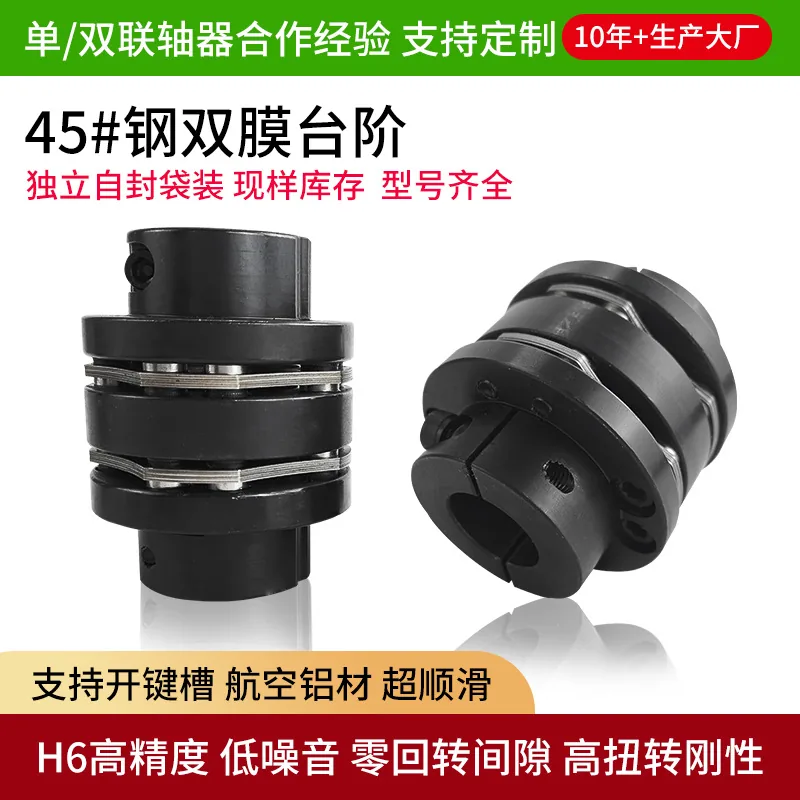
Temperature affects materials asymmetrically. In a normal dry environment, roughly between minus 20 and 80 degrees Celsius, almost every series is usable, and that covers the great majority of industrial applications. Above 80 degrees Celsius, the physical properties of TPU polyurethane decline noticeably, and continuous operation above that temperature accelerates ageing, softening and even deformation, so jaw couplings with an elastomer are out of that range. Below minus 20 degrees Celsius, polyurethane becomes brittle and cracks under cold impact, which is the same conclusion from the other direction. Both ends point to one answer: switch to a fully metal-flexure diaphragm coupling. A diaphragm series transmits torque and compensates misalignment through elastic deflection of 304 stainless steel discs, with no polymer component at all, which makes it correct at both the hot and the cold end.
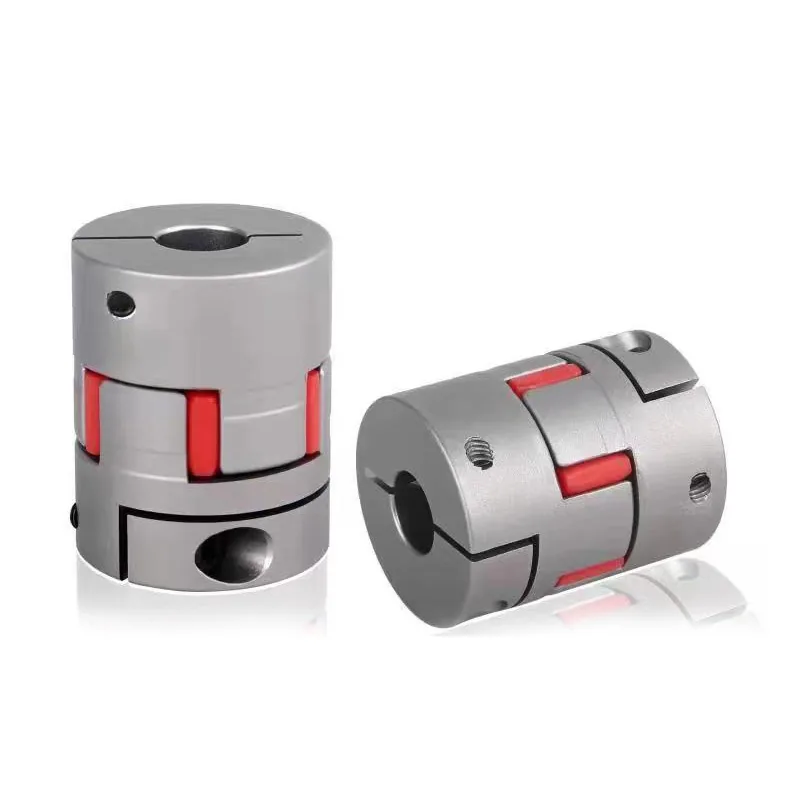
There is a conceptual trap here. A stainless jaw coupling has a 304 stainless body with excellent corrosion resistance, and many buyers conclude it is therefore suitable for high temperature. That is wrong. Its elastic element is still a TPU polyurethane spider, and its temperature limit is exactly the same as the aluminium version of the same coupling. Stainless solves corrosion and hygiene; it does not solve temperature. To judge whether a coupling can take high temperature, look not at the body material but at whether there is a polymer elastic element. If a TPU spider sits in the middle, the same temperature ceiling applies whether the outside is aluminium or stainless. The only design without a polymer limit is the diaphragm series.
In wet, splash and regularly washed areas, an aluminium body develops surface corrosion, which over time affects the dimensional accuracy of mating surfaces. The answer here is a stainless body: a stainless jaw coupling, stainless body with a TPU elastomer, suits wet and moderately corrosive environments and has a replaceable elastomer, so maintenance cost stays low. Where corrosion is more severe, acids and bases, chemical plants, coastal salt fog, you need a fully stainless construction including a non-polymer elastic element, which points to a stainless beam or cross-slider series that compensates through the metal parts themselves. Food and pharmaceutical applications add a further requirement: not just stainless, but a hygienic design, meaning easily cleaned surfaces, no traps for residue, and no plastic debris. Plastic components are a clear risk in that setting, because long-term vibration can generate fine particles that contaminate the product.
Vacuum imposes a low outgassing requirement. Polymers slowly release gas in vacuum, contaminating the chamber or affecting coating and etching processes, so vacuum applications should also avoid TPU elastomers and use a stainless body with a metal elastic element, or a diaphragm series directly. A cleanroom has a different concern: not outgassing but particles. Minute wear of plastic parts under continuous motion produces particles, and a particle landing on a wafer, an optical surface or a precision part is a defect. Cleanrooms therefore also favour all-metal construction with no plastic debris. As for explosive atmospheres, the concern is static and sparking: a metal construction does not accumulate static charge and does not generate friction sparks from internal relative sliding, which makes it safer in that setting than designs containing plastic sliders or elastomers.
Compressed into a lookup table: normal dry environment, every series works, select normally on torque and misalignment. Wet or splash, choose a stainless body such as the stainless jaw series. Severe corrosion including acids and bases, fully stainless construction including the elastic element. Food and pharmaceutical, stainless with a hygienic design and no plastic debris risk. High temperature, continuously above 80 degrees Celsius, metal construction only, choose a diaphragm series and avoid every TPU elastomer. Low temperature, continuously below minus 20 degrees Celsius, metal construction as well. Vacuum, low-outgassing material, stainless body with no TPU. Cleanroom, stainless with no plastic debris, a diaphragm series or an all-metal beam series. Explosive atmosphere, metal construction, static dissipative and free of friction sparks.
One process point to close on. Environment assessment should not wait until equipment fails; it belongs in the technical specification at the enquiry stage. In practice, tell the supplier these items explicitly: ambient temperature range, minimum and maximum, humidity and whether there is washdown, the chemical species and concentration involved, any food or pharmaceutical hygiene requirement, whether vacuum or cleanroom applies, and any explosion-proof requirement. This information changes the material recommendation directly, and it is usually free. At the same outer diameter and bore, an aluminium version and a stainless version are interchangeable, with price as the only difference. Discovering corrosion six months after installation costs you more than a coupling: it costs downtime.
After torque and misalignment, there is one more gate: can this material survive this environment?
Free Selection Help →| Payment | 50% deposit, balance before shipment |
|---|---|
| Bank transfer | Company-to-company only, no personal accounts |
| Packaging | Carton, or pallet with wooden case by quantity |
| Certification | ISO 9001 |