Precision Couplings
The same jaw coupling changes character when you change the spider, provided you choose the right hardness.
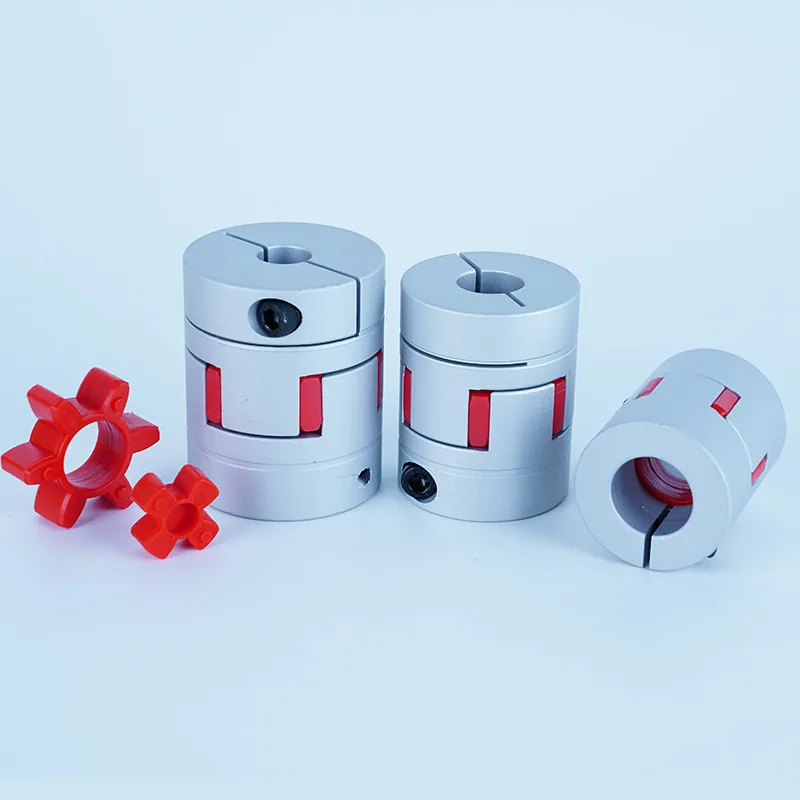
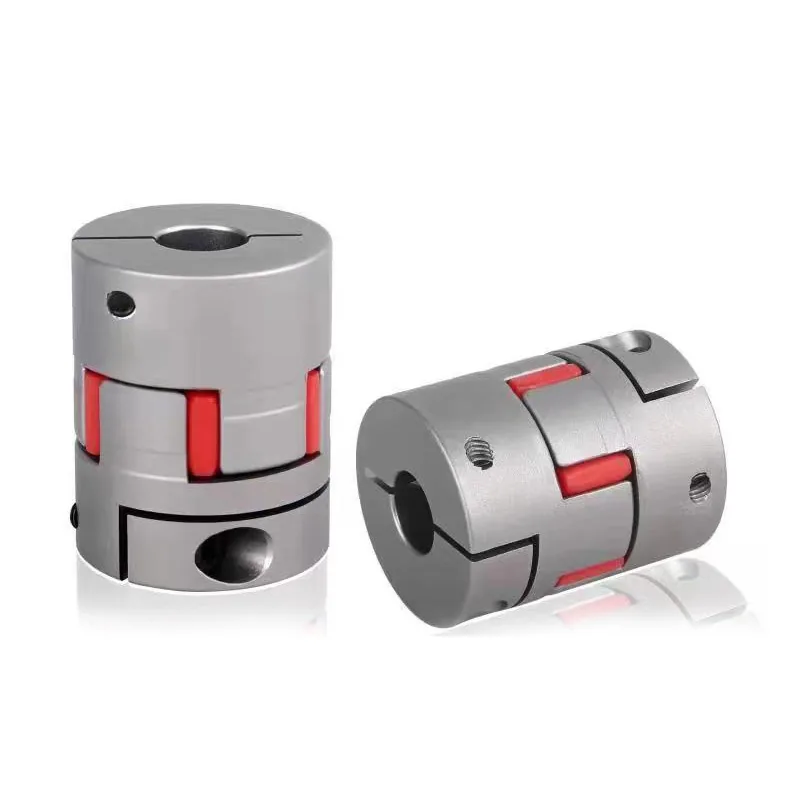
A jaw coupling has three parts: two metal hubs, aluminium or 304 stainless, and a TPU polyurethane elastomer sandwiched between them, commonly called a spider. Torque passes through compression of the elastomer, so the coupling is inherently compliant. That is both its advantage and the reason it needs a wear part. The advantage is that compression absorbs shock and damps vibration, protecting the motor and the bearings. The price is that the elastomer itself fatigues and ages, and it is the only component in the coupling that needs periodic replacement. That is precisely its value: the spider can be replaced on its own, without replacing the coupling, which keeps maintenance cost low.
Standard TPU spiders are graded by Shore hardness, and the usual three options are 92A, 98A and 64D. The 92A and 98A grades use the Shore A scale, where 98A is harder than 92A. The 64D grade uses the Shore D scale, which is a distinctly harder band. Note that the A and D scales cannot be compared numerically: Shore D uses a different indenter geometry, and 64D corresponds to the very hard end of what the Shore A scale would express. The actual order is therefore 92A softest, 98A intermediate, 64D hardest. Do not assume the larger number is the softer grade, which is a frequent and costly misreading.
At the same outer diameter and the same bore, a harder elastomer compresses less under a given torque, so it transmits more torque and gives better torsional stiffness. The flip side is that less compression means less capacity to absorb shock. A softer elastomer damps better, at the cost of greater deflection and more internal heating at the same torque, which accelerates ageing under sustained load. That is why choosing the wrong spider hardness fails in two opposite directions. Choose too hard and shock and vibration pass through the coupling into the motor bearings: the coupling survives, the bearings do not. Choose too soft and the elastomer deflects excessively under load, runs hotter and its life collapses. Both failure directions are routinely misread as a quality problem.
The physical properties of TPU are temperature sensitive, and this is the main application boundary for jaw couplings. Normal practice: if ambient temperature is continuously above 80 degrees Celsius, TPU elastomers should not be used, and a metal-flexure diaphragm series should be specified instead. A diaphragm coupling contains no polymer component at all, which is exactly why it is the right answer for high temperature, vacuum, cleanroom and aggressive chemical environments. The cold end is the same: below minus 20 degrees Celsius, metal construction is again preferred. Beyond temperature, chemical exposure matters just as much. Standard polyurethane swells or cracks in prolonged contact with certain solvents, strong acids and bases, or concentrated oils. If your process involves chemical washdown, solvent exposure or corrosive gas, an all-metal design with a stainless body is more reliable than simply changing the spider grade.
A spider is a consumable, and the replacement triggers are more obvious than expected. First, visible cracks, chips, flattened areas or discoloured patches, which usually indicate that ageing has begun. Second, vibration or noise noticeably worse than when new, with alignment and fastener tightness already ruled out. Third, degraded motion accuracy, particularly poorer repeatability on a reciprocating positioning axis, because fatigue changes the compression characteristics. When replacing, evaluate as a pair: if vibration persists after fitting a new spider, go back and check whether parallel and angular offsets exceed the rated compensation of that model. The most common cause of premature elastomer failure is not the material, it is misalignment beyond the limit.
The practical sequence is to determine the model first from torque and speed, meaning outer diameter and bore, and then take the standard hardness grade associated with that model rated torque. Hardness is not a free variable; it follows the model, and once the model is right there is usually one default answer. Adjustment is only needed when the application has an additional bias. Where stronger damping is wanted, for example shock loads or noise-sensitive equipment, one grade softer within the same model is reasonable. Where greater positioning accuracy or more torque margin is wanted, one grade harder. Any adjustment should be based on the manufacturer torque figures for that specific model, never on feel. The hardness difference shows up in the numbers far more clearly than it does in the hand.
The same jaw coupling changes character when you change the spider, provided you choose the right hardness.
Free Selection Help →| Payment | 50% deposit, balance before shipment |
|---|---|
| Bank transfer | Company-to-company only, no personal accounts |
| Packaging | Carton, or pallet with wooden case by quantity |
| Certification | ISO 9001 |